Warm Audio WA-8000 Tube Condenser Microphone
Champagne taste... beer pocketbook?
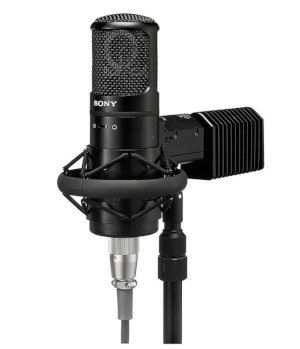
Sony C-800G - Courtesy Sony
10/21/2025
You know that feeling when you see a piece of gear and think, "What the heck is THAT?" That's exactly what got me started with this present investigation. I was seeing pictures of David Gilmour's Hove (later Medina) recording studio where he was using a unique looking mic to record his vocals. It was a mic I didn't know, with a distinctive assembly hanging off the back. I wondered what the appeal of the mic was. With a little digging, I found out that the mic was a Sony C-800G large diaphragm tube condenser. It turns out that the assembly on the back is an external tube housing and a heat sink designed to keep the tube cool and thus reduce self-noise and promote consistent performance. Before I knew all that I did know that I liked the sound of his recorded voice on the albums that had come from those studios. David's tech people have a habit of supplying him with some of the finest, most expensive gear in the world, but he has long said that he could get his sound by walking into any old guitar store and buying the gear they had in stock. He's a man after my own heart, David is: a pragmatist. I also discovered the Sony mic's price is, uh, $17,000, right in the territory of a vintage Neumann, and knew it wasn't in the future for my home recording work. However, those who love the mic LOVE it. It has become popular in the Hip-Hop movement and the engineers for Martina McBride think they remember using the mic when it was brand new to record her vocals for the song "Independence Day," way back in 1993.
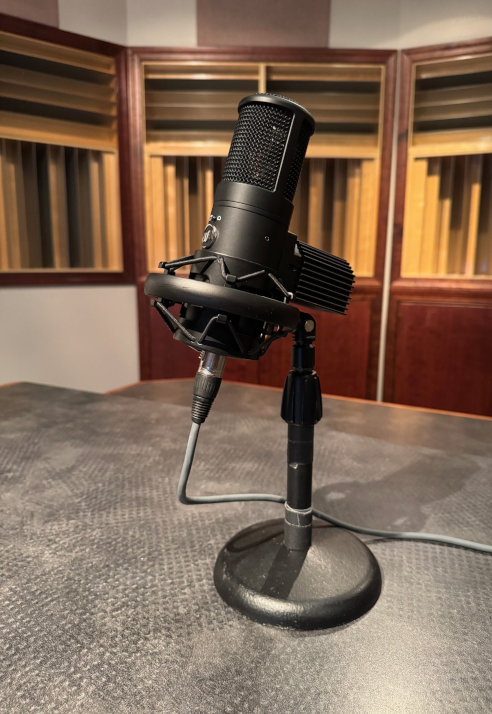
Warm Audio WA-8000
However, soon after this I discovered that a Texas company, Warm Audio, has created a component-level reproduction of the C-800G for around a tenth of the price of admission of the Sony. That has been their signature over their lifetime - reproducing classic audio device designs at a fraction of their original prices. Further research revealed that the Warm Audio offering, the WA-8000, is quite, *ahem*... controversial. Professional reviewers generally agree together that it is an entirely reasonable reproduction of the original mic and is a pleasant sounding mic that is an amazing value. At the same time, avocational mavens on recording forums gripe that it isn't even nearly an exact copy of the C-800G... and worse. I was intrigued by the contrast in views, to say the least. Then I came across a used, mint condition example of the WA-8000 that had lived its life in a nearby studio that was languishing at the local Guitar Center. I waited and watched for a couple of weeks and, et voile'!, the price dropped dramatically. The price was so low that it was hardly a gamble. I hopped down to the store, checked it for funky smells, tested it out for function, and took it to the studio where I work. Done. And now you get to hear me drone on about it.
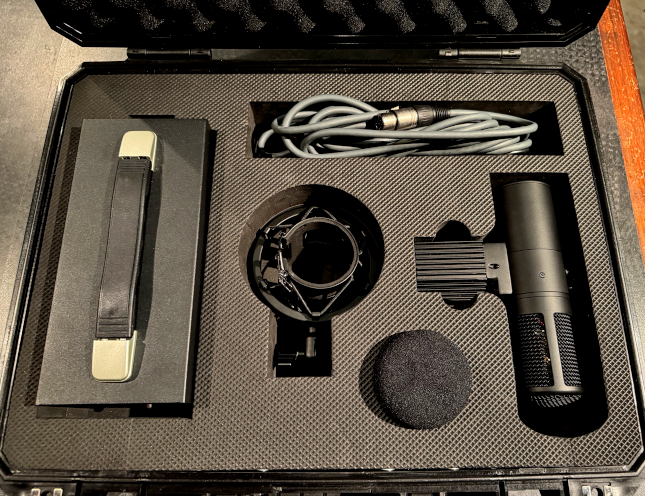
What's in the box?
Physical Examination:
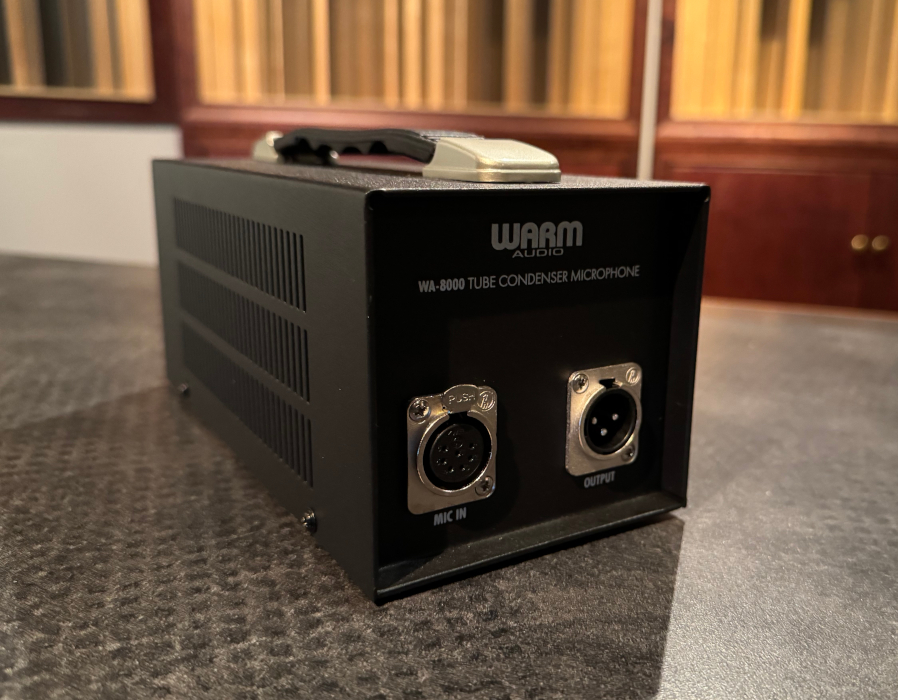
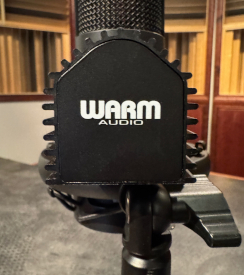
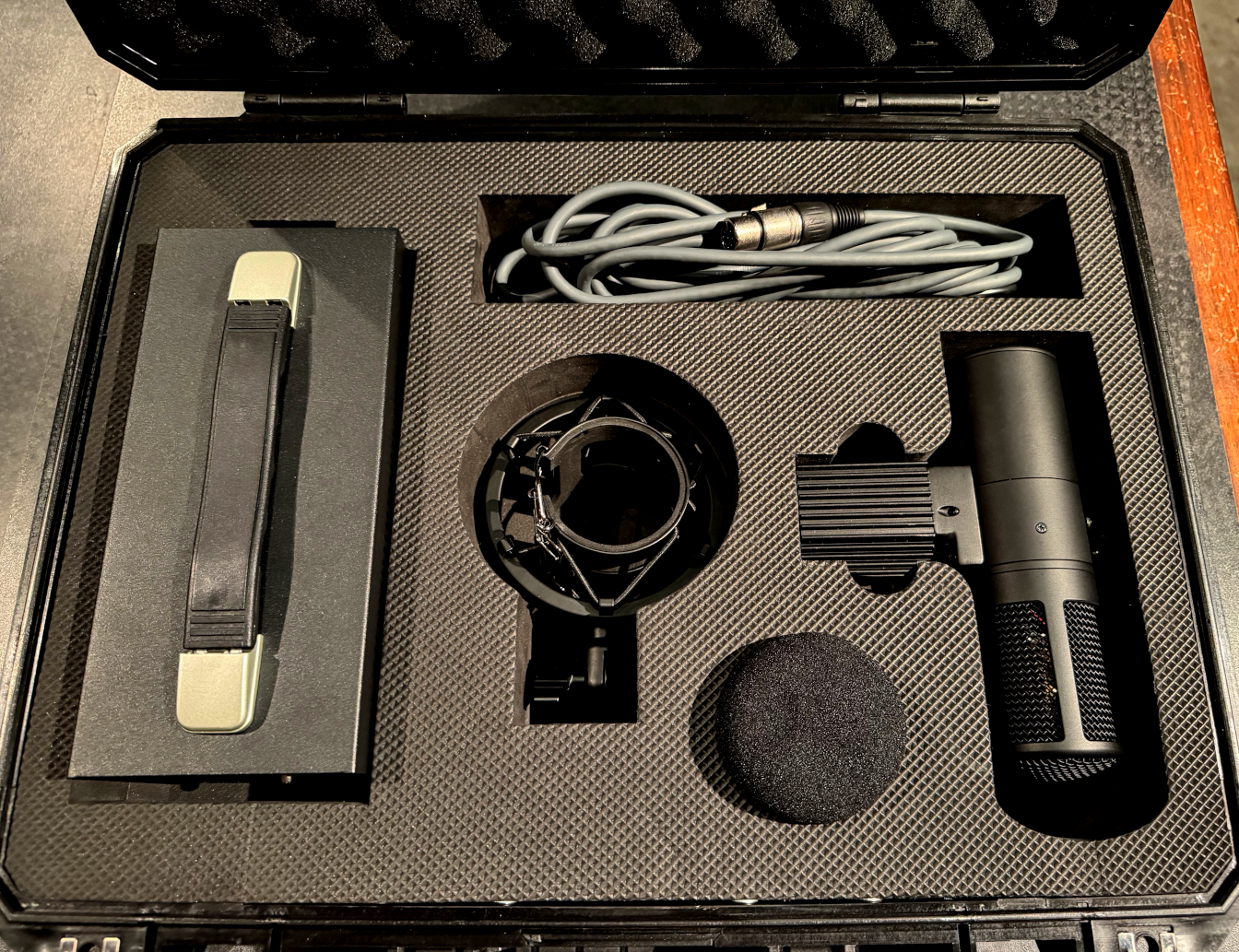
The WA-8000 arrives in a sturdy Pelican road case with the internal shock foam partitioned to hold the mic, the power supply, the shock mount, cables, and a foam windscreen. The mic's body and tube housing/heat sink are appropriately robust and are nicely finished in black on black, including the mesh head basket.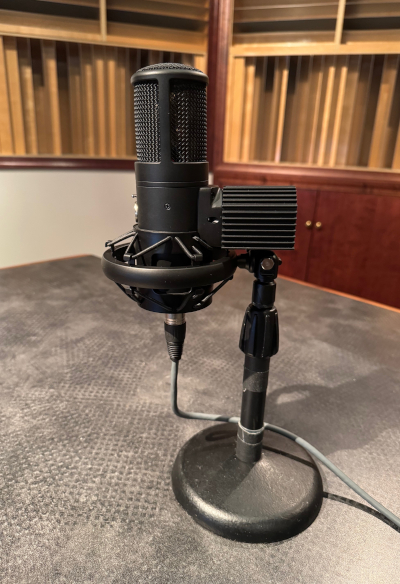 Hilariously, for those needing to "fashion match their grill", there is a gold-tone version of the mic available as well. Um, yeah. After experimentation, the designers at Warm Audio looked for ways to reduce the complexity of the Sony tube assembly that features a tube housing, a Peltier cooling chip and a separate finned heat sink. They did so by combining the tube housing with a finned heat sink, and felt that they achieved equivalent cooling performance. Looking at it, I'd venture a guess that the WA design is physically sturdier than the Sony system. The final result is a slightly smaller mic in all directions. There's heft to the mic, but not excessive weight. The separate power supply box is sized about the same as the familiar Neumann lunchbox power supplies. It is sturdy and well-ventilated and sports a lovely blue jewel power light. While the Sony supply is tube-based and large enough that it can't be fit into Sony's carry case, the WA supply is solid state and can. Everyone I've read including detractors agree that this change has no effect on the sound of the mic.
The elastic shock mount is both robust and stylish with two rubber-padded steel bands that clamp the mic into the mount. Herein is where I found the one oddity: the rubber elastic suspension cord is woven into the inner suspension ring in such a way that it appears to not be replaceable by the end user. I called Warm Audio customer service and asked about this. They agreed that it is very difficult for a consumer to replace the shock cords because it requires some specialized tools. However at design time they put a little more engineering into the cords, which are thicker than most. They don't expect the cords to fail often but are willing to replace them under warranty. A complete replacement shock mount assembly is also available on the Warm website store. Another question I had during the phone call is whether the mic could be operated upside down, as most other tube condenser mics can. The customer service agent didn't suggest running the mic upside down, not because of cooling issues, but because the shock mount isn't designed to support the mic inverted. Looking further at the assembly, it makes all sorts of sense to me now.
The mic is a component-by-component emulation of the original Sony with attention to detail down to the diaphragm mounting ring assembly being machined from brass like the Sony's K67 reproduction. Warm used custom Swedish Lundahl transformers, Wima film capacitors, and NOS French 6AU6 tubes similar to the Russian ones in the originals to build out the WA-8000. When tube replacement day comes, the tube can be accessed by unscrewing the four screws on the flat bottom of the heat sink and removing the top, finned sink. You'll want to hold the socket in place when removing the tube to prevent damage. Warm suggest that you find your own replacement tube because their stockpile was acquired when the NOS tubes were more expensive than they are now. Besides, they are sitting on their remaining stock for warranty repairs. Their attention to detail extends to using a high-quality Gotham Audio of Switzerland cable to go between mic and power supply.
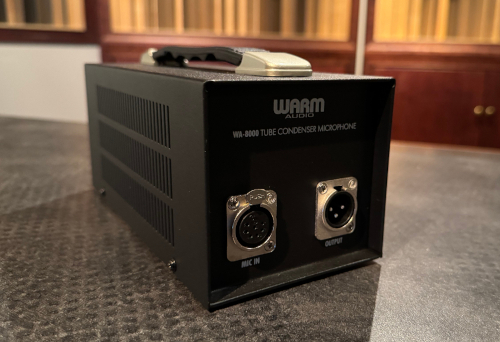
WA-8000 Power Supply. The serial number for the mic is on the bottom of this box.
Internet Controversies Surrounding the Mic:
- "It's sound isn't exactly the same as the Sony." "It needs a replacement capsule or at the very least the addition of a dome and a foam piece over the capsule mount to match the capsule resonances of the Sony." The whole mic mod movement notwithstanding, this argument reminds me of the arguments that a guitar modeler is only useful if its models of various amps are exact duplications of the original amps. Pshaw. Does it sound good? Does it match your needs? Pragmatist here. Nevertheless, there are specialistas out there who will replace your capsule and mod your circuit to make it an exact duplicate of the Sony, for a price. You can choose a real Neumann or a Sony K67. The Sony version, with the exchange of a few components, is said to make your WA-8000 sound just like a Sony C-800G. For a price.
- "I bought one and it was ruggedly constructed and then bought a second one later and the metal was far flimsier." Um... Uh... How on earth do I test this one? Everything feels robust enough to me.
- "The WA temperature modulation system is not as good as the Sony system." "The Sony cooling system is unnecessary altogether, so why reproduce it at all." Obviously, you can't please everyone. "The heat sink becomes blazingly hot in use." Huh? In my experience, after an hour and a half of operation, any heat from the WA's body, heat sink, and external power supply box was barely perceivable if you wrapped your hand around them. I really snuggled up and felt around on the silly thing trying to feel heat somewhere and all I found was barely perceivable warmth.
- "The seven-pin cable and connectors are flimsy." Sorry, I just didn't find this one to be true. Let's be honest: Neumann used those massive, Amphenol Tuchel bayonet-type connectors decades ago because they were all that were available. If you take care of your mics, the latching, XLR-style connectors on the Gotham cable should do just fine. Sure, I love those big old connectors, but you must consider the advancements in connector technology over seventy-five years and the low price you pay for the WA mic. Besides, ask me sometime about the time I got zappped while disconnecting the Tuchel connector from a U-47 power supply.
Many arguments just seem to boil down to "How can it be anywhere near as good as a $17,000 microphone when it is priced at $1299? There has to be a reason for the price difference." In fact, you can count on seeing a restatement of that basic presupposition by the time you reach the third post in most forum threads. The Internet says so and you'd better conform. Boy, that is just the thing to make me continue investigating. Let's use our ears.
An Audio Comparison:
To get a feel for the mic, I decided to compare the WA-8000 to a 1989 TLM-170. Why the TLM-170? Because it is my go-to large diaphragm condenser around the studio, even above our U-47. I know this mic intimately after over thirty-five years of daily use. Frankly, I'll confess that I went into this comparison a little skeptical of the sound of the WA-8000 because over the years I've been spoiled with nice, expensive mics, including the Neumann U-47, M-49, TLM-170, TLM-103, AKG 414, and others, but we'll see...
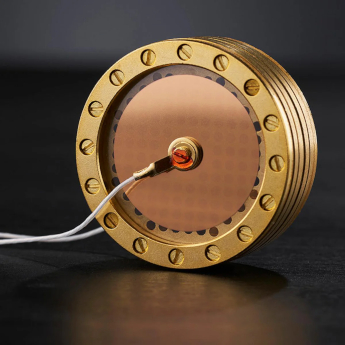
Warm Audio's take on the K67 capsule - Courtesy Warm Audio
First, let's look at historical Neumann capsule types that will influence our comparison:
- The U-47 and M49 mics started with the M7 capsule but that capsule was replaced with the K47/K49 (the K47 and K49 being identical except designation number for the respective mic models) in the late 1950s. The difference between earlier and later capsules was the material of the diaphragms, PVC versus Mylar. Both mics were designed to impart a presence peak at 4-7k to allow a voice to be heard over an orchestra, and they did it well. Both also became legendary for their sound when applied to solo voice and instruments, imparting a certain "rip" to a warm male voice.
- The U-67 (tube) used the K67 capsule, which was designed to impart a gentle high-end lift to give the subject "air" and sparkle. Both the Sony C-800G and Warm Audio WA-8000 use emulations of this capsule.
- The U-87 (solid-state) uses the K87 capsule, a K67 redesigned to allow multiple polar patterns and match the solid-state electronics of the U-87.
- The U-89 and TLM-170 use the K89 capsule which was designed in direct response to the popular opinions surrounding the change from analog to digital recording. The popular voices demanded NO pre-emphasis in microphones for digital recording. The K89 was to be an improvement to the K67 that removed its high-end lift. It did, in fact, remove the lift, and imparted a slight drop in the frequencies between 3k and 6k by 2db. The TLM-170 is a transformerless, solid state design. It is a very quiet, warm, smooth microphone. When Neumann put out the U-89 and TLM-170, they discontinued the U-87.
Confused? Well here we go...
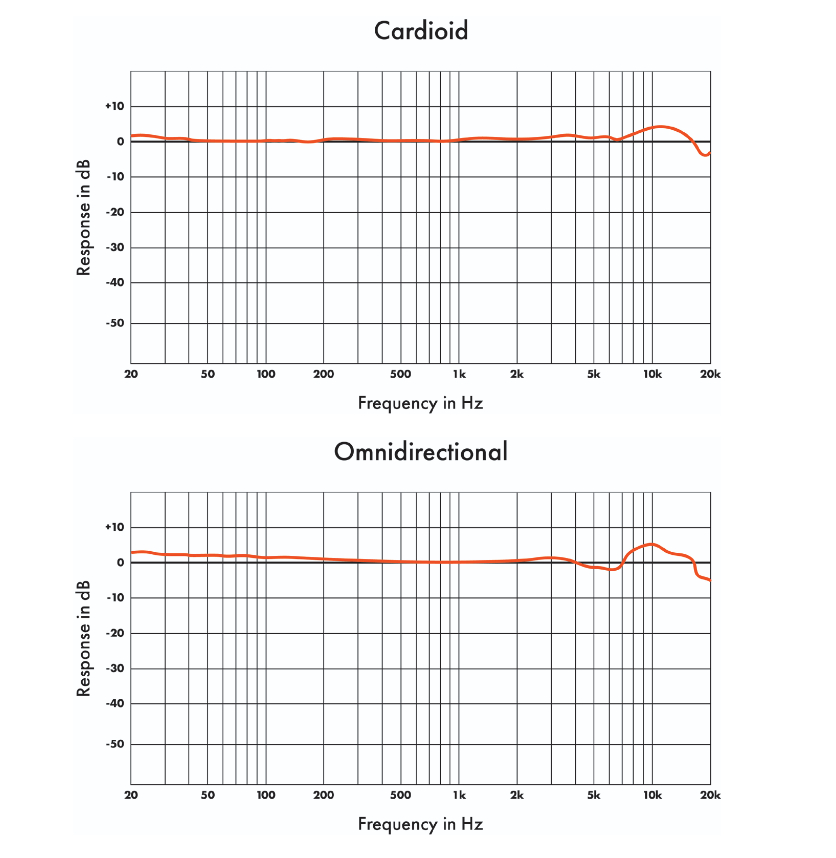
As stated before, the Warm Audio WA-8000 is designed to emulate the Sony C-800G mic, a 1992 design, on the component level. Right on the cusp of other manufacturers dropping the high-end pre-emphasis and issuing new models, Sony bucked the popular trend and chose the K67 capsule for their C-800G. It was a good decision, because it turned out that some producers and engineers still wanted that slight lift on their vocals. The mic became known for its solid bass paired with an airy high-end with a lift of about 7db from 8k to 15k. For their WA-8000, Warm Audio also created their own emulation of the K67 capsule right down to the brass diaphragm mounting ring. You can see in the chart below that the capsule lifts response in a smooth curve peaking at about 4db between approximately 7k and 15k.
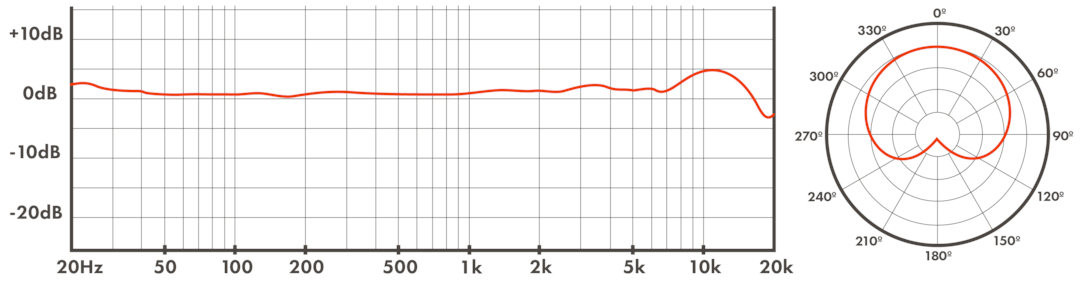
WA-8000 Cardioid Response. Click for Cardioid and Omni Graphs. Courtesy Warm Audio
Voice Test (spoken word)
I've found that spoken word can reveal a whole lot of the character of a mic, and especially a large diaphragm condenser mic. For this test I mounted the two mics on large Atlas studio stands and placed them side-by-side in the studio, each with a pop screen. I set them to their basic cardioid patterns because that is the pattern that will most likely be used by home recordists and the pattern I use day-in-day-out. I fed each mic into an Avalon VT737 tube channel with the EQ, compression, and high-pass filter turned off. I recorded them into the DAW with the controls set for equal indicated gain to allow me to see what difference in gain might exist between the pair. I used myself as the sample voice and read the introductory paragraph from the Warm Audio user's manual that I downloaded from their site.
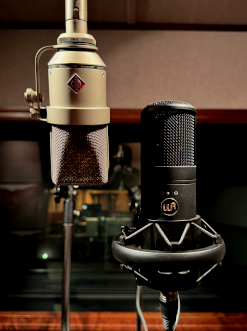
Before I mounted the pop screens
What did I find?
Firstly, it is absolutely clear that these mics' capsules are brethren. Their sounds have more in common than they have differences. The WA-8000 has about 2db more gain than the TLM. It also exhibits more self-noise, mostly in the low end, as you would expect from a tube mic - it's all those electrons banging around inside the tube. I observe the same sort of noise with the U-47 and other tube mics I've worked with. Unless you really crank up the level with the mic soloed and no sound present in the room, which I did, you can't tell that the extra tube noise is there. The TLM-170 picks up quite a bit more ultra low-end room rumble than the WA. However, and you can see it in my side-by-side pictures, the TLM-170 is directly hard-mounted to the stand while the WA-8000 rides in a shock mount. I would assume that this is probably the reason. Be that as it may, the WA appears to have a more open cardioid pattern than the TLM. This became obvious because the transient sound of the studio door opening and closing at 90 degrees off-axis was picked up a bit more by the WA than the TLM.
With my baritone voice, I found the two microphones to be remarkably similar in the midrange. Though it is a very faithful, flat microphone, because of its flat high end and slightly suppressed up-mid response, the TLM might be considered a touch "boxy" by those who aren't comfortable with using EQ. The WA indeed adds some more "air" to the subject than the TLM offers and a certain upper end "rip" that might help a male voice cut through. Because I often end up adding air to voices via EQ when using the TLM, the WA seems like it could eliminate that need. The upper-end sheen is quite smooth and pretty and isn't strident. If the subject is sibilent in the 7-15k range, that will, of course, be emphasized by the brighter upper end.
In a test of proximity effect, I spoke into the mics at four distances: two handbreadths, one and a half, one, and about two inches with my nose tucked between the pop screens. As expected, the TLM showed a steady low-frequency rise as you approached it. By contrast, the WA showed far less rise, right until you got up on it at two inches. It never had as much bass tilt-up as the TLM. It also was far less susceptible to being popped when I was up close than the TLM was. At two inches the TLM exhibited pretty strong transient pops, even with the pop screen in place, while the WA's pops were far more tame. This could be a result of the TLM's tighter cardioid pattern or its thirty years of breaking in. Now, part of the popular attraction to the Sony C-800G is a robust low end and an airy bottom end. As you will see later, the more flat bottom end and reduced proximity effect of the WA-8000 play into my appreciation of it in particular applications.
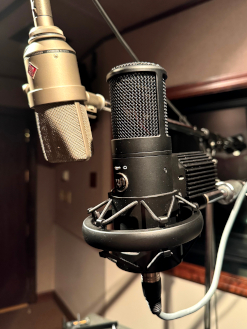
~ Brethren ~
Guitar Test:
To see how the two mics compared when deployed to pick up a guitar, I trotted out my "maid of all sessions" 2001 Taylor 314kce Grand Auditorium acoustic with the two mics pointing roughly at the neck joint and about one foot away. I removed the pop screens for this test. The TLM's output sounded a little more round than the guitar does in real life, exhibiting a little less high end sparkle and upper-mids than I am used to when listening to the actual guitar. You can actually hear the slight upper-mid dip that it exhibits. I've become used to that mic after thirty-five years and know how to get what I want with it through EQ. Again, in these tests, the WA imparted a nice sheen or shimmer to the top end of the guitar that I found quite attractive and that might render the recording more mix-ready for those home recordists who like a touch of sheen. It is notable that the WA-8000 showed this character in this test where inches count, despite being the mic positioned closer to the guitar's body and sound hole where bass and mids tip up more. But, by way of comparison and to be fair, the WA is a tiny bit brighter than what I hear from the playing position when playing the guitar.
Conclusions:
I went into this purchase and comparison with specific goals. As I stated earlier, I was expecting to be disappointed. I shared the question, "How can the Warm Audio mic approch its brethren at such a low price point?" with the skeptics. The goals were to find an affordable mic with a little more top-end sheen and a little less proximity effect than other LDCs that I use. Why? What is one of the biggest challenges in home recording? It is untreated rooms that cause unwanted ambience. Without treatment, what is your other option? Proximity to the mic!!! If you can get closer, you can drown out the background to one extent or another. Of course, getting up close can also tip up the bass on some mics because of the proximity effect imparted by a tight cardioid pattern. So, how did the WA-8000 perform? I was utterly surprised and impressed. The WA-8000 achieved my technical goals and turned out to be a very pleasant sounding microphone as well. Now obviously, taste in microphones is highly subjective. What one person sees as beneficial, another may detest. In fact, choice of microphones changes with both the subject and application. Purely aesthetically, there is a world of recording philosophy and taste involved in just the choice of high-end tilt up or not. The absolute latest trends in mixing favor mixing for AirPods, and a darker sound is sought. But given its strengths and overall sound, I think the WA-8000 will be a good tube vocal and instrument mic for around home. In fact, I think a home recordist could very easily add one of these to his mic collection and not feel the least deprived of better mics. Its attractive $1299 list price brings first-rate performance within reach of home recordists. It truly is a great era to be involved in recording!
Specifications:
The more expensive the mic, the more detailed and precise the specs. Just sayin'.
Max SPL: 131dB (cardioid), 134dB (omnidirectional)
Dynamic Range: 113dBA
Output Impedance: 100 ohms
Rated Load Impedance: ≥1k Ohms
Signal to Noise Ratio: 76dB (cardioid), 73dB (omnidirectional)
Sensitivity: -34dB (cardioid), -37dB (omnidrectional)
Self Noise: 15dB (cardioid), 17dB (omni)
Frequency Range: 20 Hz~20 KHz
Capsule: All brass frame, Gold Sputtered, Dual Large Diaphragm, Single Backplate, 6 Micron, NOS Mylar (PET Film), K67 inspired
Tube: New Old Stock 6AU6
Features: External Heat Sink
Color: Black
Power Source: External power supply
Connector: XLR
Mic Dimensions: 7.5" x 2.5"
Included Accessories: Hardshell Case, Shockmount, 16.4' GAC-7 Cable
Weight: 13.3 lbs, total weight in case
WARM AUDIO WA-8000 WEBSITE
= =
=
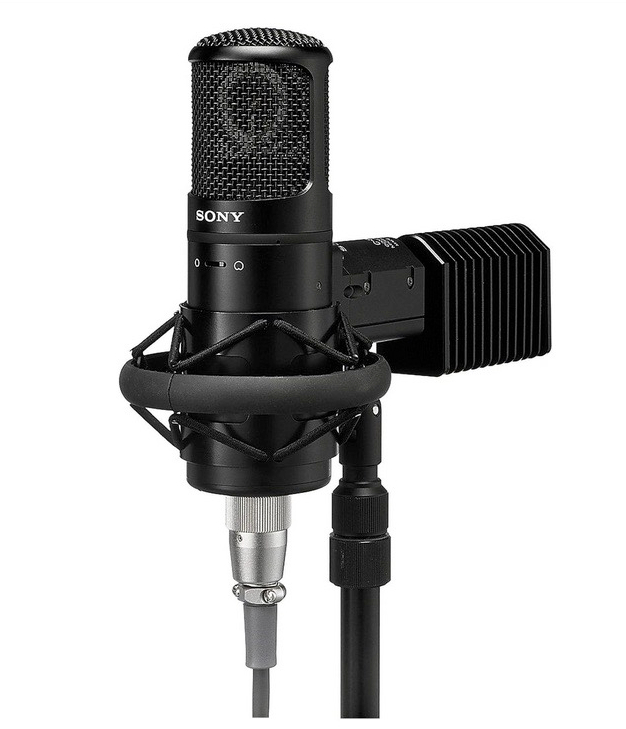
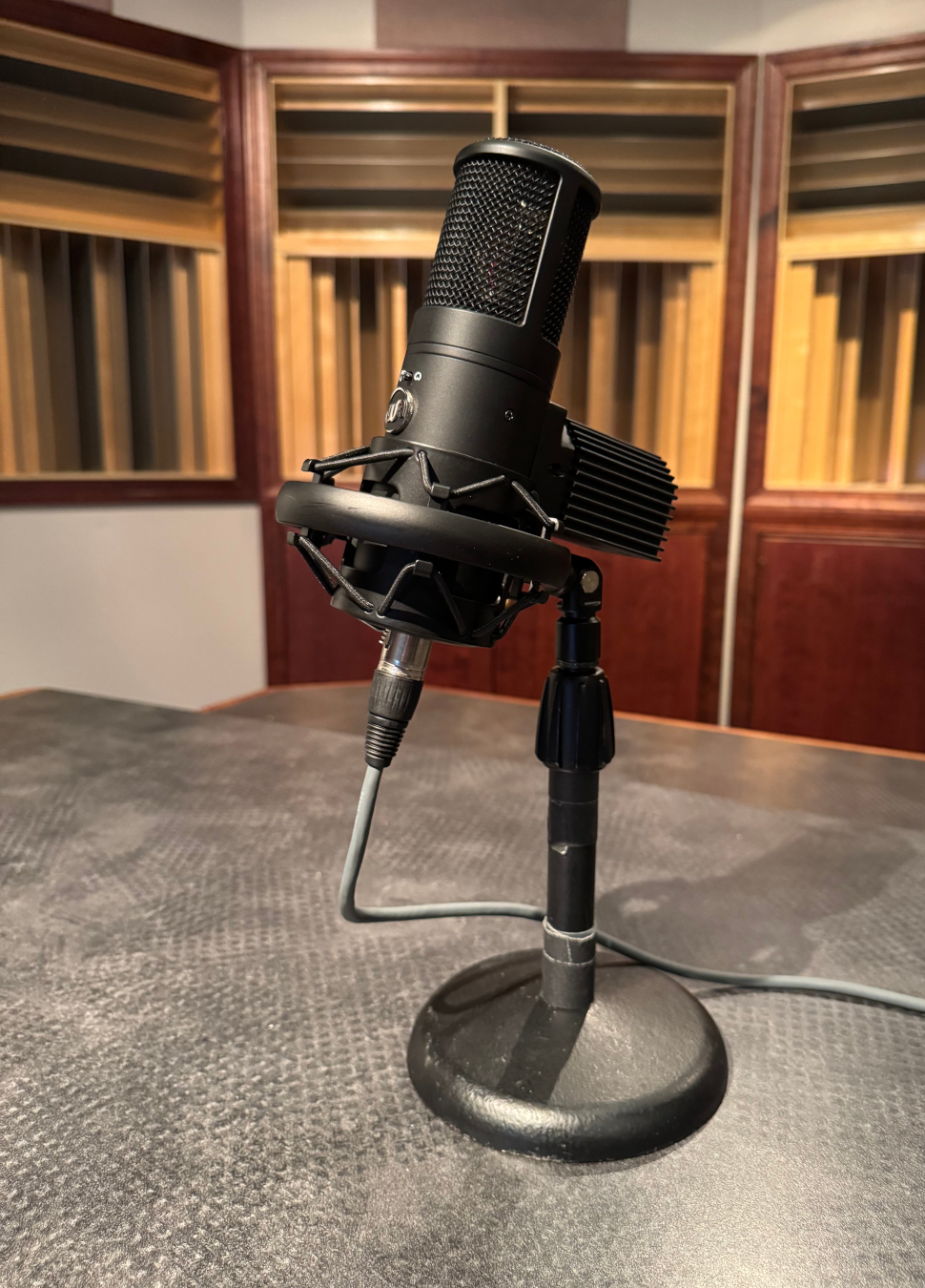
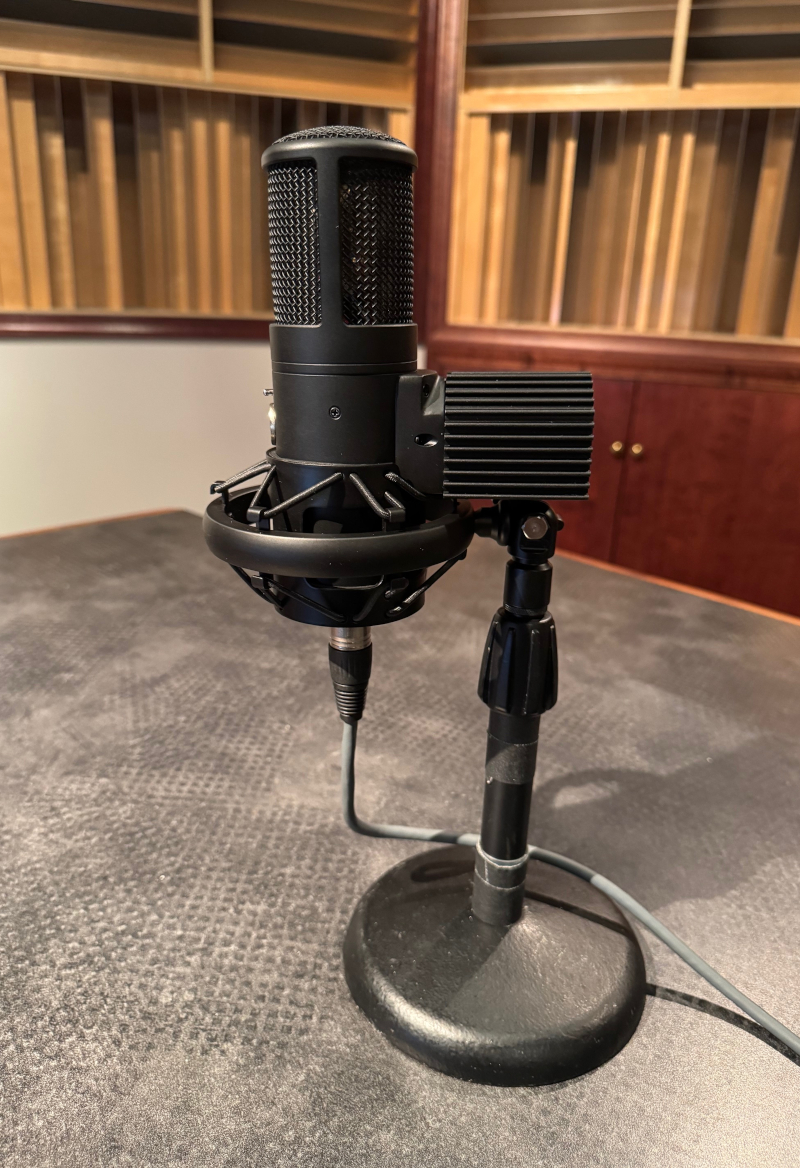 Hilariously, for those needing to "fashion match their grill", there is a gold-tone version of the mic available as well. Um, yeah. After experimentation, the designers at Warm Audio looked for ways to reduce the complexity of the Sony tube assembly that features a tube housing, a Peltier cooling chip and a separate finned heat sink. They did so by combining the tube housing with a finned heat sink, and felt that they achieved equivalent cooling performance. Looking at it, I'd venture a guess that the WA design is physically sturdier than the Sony system. The final result is a slightly smaller mic in all directions. There's heft to the mic, but not excessive weight. The separate power supply box is sized about the same as the familiar Neumann lunchbox power supplies. It is sturdy and well-ventilated and sports a lovely blue jewel power light. While the Sony supply is tube-based and large enough that it can't be fit into Sony's carry case, the WA supply is solid state and can. Everyone I've read including detractors agree that this change has no effect on the sound of the mic.